


What Are Obliques? Your Guide to the Muscles That Actually Make Your Core Work
Your Guide to the Muscles That Actually Make Your Core Work
Obliques are the diagonal muscles running along both sides of your core. Two layers – external and internal – working together to control rotation, side bending, and spinal stability. Most people only train the front of their core and completely skip the sides. That’s exactly what we’re fixing here.
Ask most people to point to their core and they’ll wave at their stomach. Ask them to name the muscles and you’ll get “abs” – the rectus abdominis, that vertical band down the front. Nobody mentions the obliques. And that’s a problem, because the obliques are the muscles that actually make your core functional, stable, and defined.
This guide breaks down what your obliques are, what they do, why they matter more than you think, and how to train them effectively – whether that’s through reformer work, HIIT, or both.
The Anatomy of Oblique Muscles
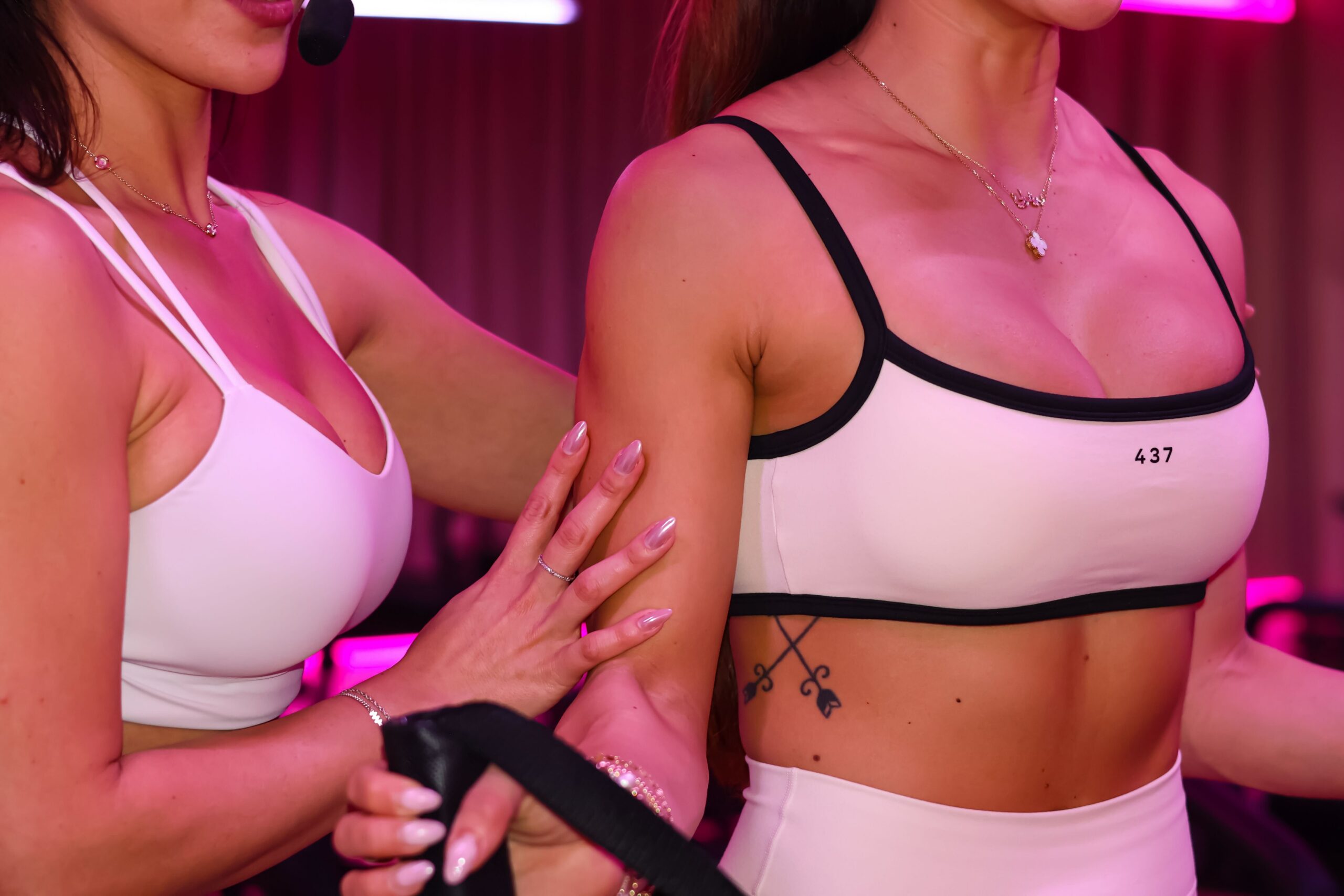
Your obliques are two distinct muscle layers stacked along each side of your torso. Think of them as your core’s power steering – without them, you’re not rotating, stabilizing, or moving with any real control.
External Obliques
- Location: The outermost layer. They run diagonally from your lower ribs down toward your pelvis – picture the angle of your hands slipping into jacket pockets.
- Fiber direction: Down and toward center.
- What they do: Rotate your trunk to the opposite side, bend you sideways, compress your abdomen.
These are the muscles that fire when you twist, reach, or power through a rotational movement.
Internal Obliques
- Location: Beneath the external obliques, running in the opposite diagonal – upward and toward the center from the pelvis.
- Fiber direction: Up and toward center (perpendicular to the externals).
- What they do: Rotate your trunk to the same side, assist with lateral flexion, support forced exhalation, and create deep core compression.
Here’s what makes these two layers so powerful: they work in opposition. When you rotate your torso to the right, your left external oblique and right internal oblique fire simultaneously. This is exactly why oblique training demands rotational movement – standard crunches don’t come close to recruiting either layer properly.
Both layers contain a mix of slow-twitch and fast-twitch muscle fibers, which means they respond to endurance work and high-intensity training. This is one of the reasons HIIT-based oblique training on the reformer – where you’re combining sustained tension with controlled, explosive movement – is so effective.
What Do Your Obliques Actually Do?
Your obliques do three things. All of them are essential to how you move every single day. And, fun fact: your obliques are the first muscles you use when you wake up in the morning.
Three functions – All essential:
The bottom line:
Crunches alone don’t train the obliques in any meaningful way. The science backs this up – rotational and anti-rotation exercises produce significantly higher oblique activation than traditional flexion-based core work.A 2015 review in the Journal of Strength and Conditioning Research found that oblique activation was significantly higher during rotational and anti-rotation exercises compared to traditional flexion-based core work – confirming what movement specialists have observed clinically: crunches alone do not train the obliques in any meaningful way.
Best Exercises for Internal and External Obliques
How to Train Your Obliques
So how do you actually workout your side abs? They sit in opposite diagonal orientations, which is exactly why they work as a pair. Understanding the difference matters because they’re not interchangeable – and training them requires different approaches. In practice, most oblique exercises hit both layers simultaneously – especially rotational movements. To specifically target the internal oblique, you need anti-rotation exercises where your core resists force rather than creates it.
These are the movements that work – movements that are backed by research, tested in the studio, and built into every FORM50 class for a reason.

Exercise 1 – FORMulator
Targets: Internal/External Obliques, Transverse Abdominis, Hamstrings & more Holding a table top position and sweeping one leg down with tension forcing the torso and hips to remain stable and still while moving the heaviest limb on your body.
Exercise 2 – Side Plank
Targets: Internal/External Obliques, Transverse Abdominis, Glute Medius, Rotator Cuff
Holding a straight line from head to heel on your forearm, can also be done on the knees. Your obliques contract isometrically to prevent your hip from dropping – that’s lateral anti-flexion, and research shows the side plank produces higher oblique activation than 10 other common core exercises. Holding it on the FORMFormer makes you have to hold the carriage still which adds an additional stability challenge. Simple and effective.

Exercise 3 – Kneeling Torso Twist / Woodchop
Targets: Internal/External Obliques, Transverse Abdominis, Delts, Chest, Lats, Hip Abductors
A horizontal/diagonal chopping motion – straight across or low to high – using a cable pulling against tension. The movement follows two main patterns of the oblique, twisting and diagonal twisting. Training the natural diagonal fiber direction of the external obliques through a full rotational range with resistance both ways.
Exercise 4 – Teaser / Corkscrew
Targets: Internal/External Obliques, Transverse Abdominis, Delts, Chest, Adductors
This is where the FORMFormer changes the game. Spring-loaded resistance creates constant tension throughout the entire range of motion – unlike bodyweight movements where the muscle is unloaded at the end. Teaser and Corkscrew trains anti-rotation and rotation under eccentric contraction which is one of the most effective ways to build oblique length and strength at the same time.
Why the FORMFormer Is Built for Oblique Training
Here’s the issue with most oblique exercises: they load the muscle at one point in the range of motion and give you almost nothing at others.
The FORMFormer changes this completely.
The spring-cable system applies resistance throughout the full range of motion – not just at the hardest point. That means time under tension across the entire muscle, which the research consistently identifies as a primary driver of strength, hypertrophy and muscle development.
It also enables unilateral loading – one side working independently of the other. This forces each oblique to stabilize the spine without compensating through the opposite side, developing deep stabilizing function in ways bilateral exercises simply can’t replicate.
At FORM50, every Total Body Sculpt class includes direct oblique work on the FORMFormer. The combination of HIIT-based Pilates inspired movement and metabolic intervals means your obliques are trained for both strength and endurance within the same 50-minute session. See the full class breakdown here.
5 Signs Your Obliques Are Weak
Most people don’t realize their obliques are undertrained until something else starts to hurt. Watch for these:
Chronic lower back pain Especially on one side. Weak obliques mean the lumbar spine is absorbing rotational and lateral forces it was never designed to handle alone.
Poor rotational range of motion You can’t turn fully to look behind you without shuffling your feet, or you rotate much further one direction than the other.
Hip drop during single-leg exercises Lunges, step-ups, single-leg deadlifts. If one hip drops, that’s often weak obliques and glute medius on that side.
Balance feels disproportionately hard The obliques are stabilizers. When they’re weak, anything on one leg or an unstable surface becomes way harder than it should be.
Side stitch during cardio A persistent stitch on one side during running or cycling can signal oblique weakness forcing the diaphragm to overwork for breathing stability.
Your obliques aren’t a secondary muscle group. They’re the rotational engine of your core, the primary stabilizer of your lumbar spine, and the muscles most responsible for how you actually move in real life. Train them directly – with rotation, lateral load, and real resistance – and everything else in your training gets better.
Book a Class – We Can’t Wait to See You
FORM50 classes run 7 days a week – morning, midday, and evening – at every location:
- Astoria, New York
- Midtown East, New York
- Williamsburg, Brooklyn
- Brooklyn Heights
- Miami, Florida
- Boca Raton, Florida
Ready to feel the difference? Every FORM50 class is built to train your core the way it’s meant to be trained – functional, science-based, and results-driven. Book your first class and see what 50 minutes can do.
Frequently Asked Questions
What’s the difference between obliques and abs?
Your rectus abdominis (the “six-pack”) runs vertically down the front and handles spinal flexion – the crunch motion. The transverse abdominis is the “corset” of your spine and stabilizes you. Your obliques run diagonally along the sides and handle rotation and side bending. Both are part of the core. They do entirely different jobs and need entirely different exercises.
Can you overtrain your obliques?
Yes. Like any muscle group, they need recovery. Give them 24-48 hours between direct training sessions. At FORM50, oblique work is built into our Total Body Sculpt sessions alongside full-body programming, which reduces overtraining risk compared to hammering oblique-only workouts daily.
How long until I see results?
Training consistently 2-4 times per week, most people notice improved core stability and posture within 4-6 weeks. Visible muscle definition in the obliques typically shows up around 8-12 weeks of consistent training paired with solid nutrition.
Will oblique exercises make my waist bigger?
No. Training obliques builds muscle and improves posture, which typically creates the appearance of a more defined, narrower waist. HIIT-based oblique work – the kind we do at FORM50 – emphasizes control and endurance over heavy loading, so you’re building tone and definition, not bulk.
What does a strained oblique feel like?
A sharp or pulling pain on one side of your abdomen or back that gets worse with rotation, side bending, coughing, or deep breathing. If you feel this, stop training immediately and see a medical professional before doing any more core work. Don’t push through serious oblique pain.